

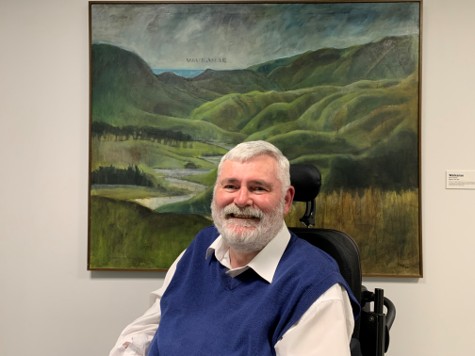
By Dr Gerald John Rys
The beginning of a different life
In 2000, I developed optic neuritis. At the time, I could not have known just how significant this episode would become. Two years later, in 2002, I was diagnosed with multiple sclerosis (MS). I remember the uncertainty that accompanied the diagnosis, especially the realisation that no one could tell me with confidence how quickly the condition might progress or how it would ultimately affect my life.
The neurologist told me that I was unlucky to be diagnosed with MS at my age. MS is more commonly diagnosed in younger adults, and receiving the diagnosis later in life was not what I had expected. The comment stayed with me. I could not change the diagnosis, but I would have to learn how to live with it and make the most of the abilities I retained.
I had spent much of my life approaching problems through science and evidence being a scientis and science advisor. MS presented a different kind of problem: one that was deeply personal and for which there was no predictable solution. I soon discovered that understanding a disease scientifically is very different from experiencing its effects on your own body.
The gradual loss of mobility
In the years after my diagnosis, my walking deteriorated. Things I had previously done without thinking became progressively more difficult. There was no single moment when life changed completely; rather, there was a succession of adjustments as my legs became less reliable and everyday activities demanded more planning and effort.
By 2008, I was dependent on a wheelchair. That was a major change in my life. A wheelchair gave me a way to remain mobile, but it also brought an immediate awareness of how much of the world is designed for people who can walk. Steps, narrow doorways, unsuitable toilets, inaccessible vehicles and uneven surfaces all became practical obstacles.
Over time, I also lost much of the function in my right arm and hand. I had to learn to do more with my left hand, including typing. Ordinary tasks took longer and frequently required assistance. The loss of physical independence was difficult to accept, particularly when I remembered how easily I had once moved around.
Importantly, although MS has affected my physical capabilities severely, I have continued to feel mentally alert. My curiosity, judgement and interest in agriculture and the world have remained. I have tried not to allow what I cannot do physically to determine what I believe I can still contribute as a person.
Treatment and an unexpectedly stable period
My treatment history has been relatively limited. Apart from approximately two years on interferon, I have not been treated with disease-modifying drugs for MS. The interferon treatment was stopped following a Pharmac decision because it was not considered to be limiting the progression of my disease.
For a condition like MS, that uncertainty is difficult. It is natural to hope that treatment will slow or prevent further losses, but my experience was that the disease continued to affect my mobility despite the period on interferon.
Nevertheless, touch wood, my MS has been relatively stable for about the past 15 years. I am conscious that this is something for which I should be grateful. Stability does not reverse the disability that has already occurred, and it does not mean that life is easy. It does mean that I have been spared the continuing deterioration that I once feared might occur.
I make no claim that my experience predicts what will happen to anyone else with MS. It is an unpredictable disease, and each person follows a different course. I can only describe what has happened to me.
Susan and the strength of our family
The most important part of my story is the support I have received from my wife, Susan, and our family. Susan and I have been married for 53 years. Over those years we have shared the ordinary experiences of family life as well as challenges that neither of us could have anticipated. My MS diagnosis changed life for both of us, not just for me.
Susan has been a constant source of strength. As my physical abilities declined, she took on an increasing share of the practical demands of daily living. She has helped with the things that are easily taken for granted until they can no longer be done independently: getting ready for the day, managing appointments and transport, planning around access difficulties and dealing with the unexpected complications that disability brings.
But her support has been far more than practical assistance. She has provided reassurance when the future seemed uncertain, encouragement when frustration took over, and the companionship that makes the hard days manageable. She has respected my wish to remain active and independent in the ways still possible, rather than allowing MS to dictate every aspect of our lives.
I know that caring for someone with a severe physical disability can place considerable demands on a partner. It affects time, energy, freedom and the choices that a couple can make. Susan has borne those demands with extraordinary commitment. Much of what I have been able to achieve would simply not have been possible without her support.
Our family has also made an enormous difference. Their understanding, help and encouragement have ensured that I have never had to confront MS on my own. They have helped me retain a sense of belonging and normality, even as the practical details of family activities have had to change.
When people acknowledge what I have achieved, I regard that recognition as belonging in no small measure to Susan and our family. My achievements have never been mine alone.
Other health challenges
MS has not been my only health challenge. In 2008, I required coronary stents for heart disease, and I have also developed type 2 diabetes, for which I use insulin daily. These conditions have added further demands to a life already shaped by disability.
Living with several long-term conditions requires organisation, medical care and patience. There are days when even apparently straightforward activities require a disproportionate amount of effort. I have learned to accept help where it is needed, while continuing to value the areas of life in which I can exercise choice and independence.
Throughout these challenges, Susan’s support has remained central. Her contribution is not something that can be separated from the way I have managed my health or continued to participate in the things that matter to me.
Retirement and the daily journey
I have recently retired from the public service after 51 years as a scientist and science advisor. What I will not miss is the daily journey to and from work. For the last 18 years, I travelled by bus and train in my wheelchair, spending three hours on public transport each working day, three to five times a week.
At least I can say that taking public transport helped to keep my greenhouse gas emissions down. I have also seen improvements in accessibility on public transport and in our streets in recent years. Having made that journey for so long in a wheelchair, I appreciate the difference these changes can make.
Recognition and perspective
I have been fortunate to receive recognition for my contributions to science, agriculture and public service over the years, including the L. I. Grange Medal in 2016 in soil science, the MPI Director-General’s Science Prize in 2018, the Ray Brougham Award in 2020 for my research in grasslands science and the New Zealand Public Service Medal in 2021 for my commitment to public service over 45 years.
These honours have meant a great deal to me, particularly because they came during the years when I was living with substantial disability. They reminded me that a person can lose physical functions without losing knowledge, purpose or the ability to make a worthwhile contribution.
I do not regard these awards as evidence that I overcame MS. The disease is still with me and its effects are part of my daily life. Rather, I see them as a reminder of what can remain possible with determination, appropriate assistance and, above all, the support of people who care.
Travel and the outdoors
What I do miss is the ability to travel widely. In my younger years, I visited some interesting places: the Maldives in the Indian Ocean, with islands just one to two metres above sea level; the Altiplano region of northern Chile with its alpaca; and Easter Island, where I saw the moai. These are experiences I am glad to have had, although I miss the freedom to make journeys like them now.
I also miss being able to enjoy nature fully, to go on bush walks and to walk New Zealand’s great walking tracks. Living by the sea, I find it particularly disappointing that I cannot fully enjoy walks along the beach. Wheelchairs, sea and sand do not mix. These are some of the everyday pleasures that I miss, alongside the more distant travels.
What living with MS has taught me
Living with MS for more than two decades has changed my understanding of independence. I once thought of independence largely as being able to do things for myself. Now I see it more as being able to make decisions, maintain relationships, exercise judgement and continue to lead a meaningful life, even when physical assistance is essential.
I have also learned how important it is not to judge a person by a wheelchair or by the tasks they can no longer perform. Physical disability and intellectual ability are not the same thing. People who live with significant disabilities still have experience, ideas, interests and aspirations. They want to be treated with dignity and included in ordinary life.
There have been frustrations and losses. I would not pretend otherwise. But there have also been pleasures, friendships, family occasions and achievements that MS has not taken away. I have tried to concentrate on those things, while recognising the reality of the limitations I face.


Last Updated November 3, 2026