

Written by Sophie Wilson BHs, (Neuromuscular Massage Therapist that just happens to have RRMS)
So, you’ve just been diagnosed with MS? Welcome to the club! You’re officially elite! (Well that’s what I like to think!)
Getting a diagnosis like this is something that a lot of people have an opinion about, even those who you may not have talked to in a while.
But the best advice I heard was from one of the nurses at Auckland hospital she said, “ trust me, in a year to 18 months MS wont even be a big deal”. To be honest I thought, “Yea right! How can it not be at the front of my mind, that’s all it’s been for the last 3-4 months!” But of course, she was right!
I have MS (the relapsing kind) but one of the more important parts to me is that I am a degree qualified neuromuscular massage therapist. Although I did my study and first years of clinic before being officially diagnosed, there were a few things that have happened which do indicate some things weren’t quite right years prior to diagnosis, but there’s always another explanation to symptoms right? Symptoms which you could pin down as “normal” being in my mid-late 20s – burn out, fatigue, emotional overwhelm and an ever so subtle left eye delay when blinking.
I started treatment via an intravenous infusion that took ALL day, which for me, a self employed business owner, was a big change to my schedule and normal routine. Luckily I didn’t have to have too many of these all day hospital stays before the sub cut injection became available! Oh goodness… It was a complete game changer! To be able to go in for an hour or two, get my medication and be able to be home before lunch time… just so quick, hasslefree and totally chill!
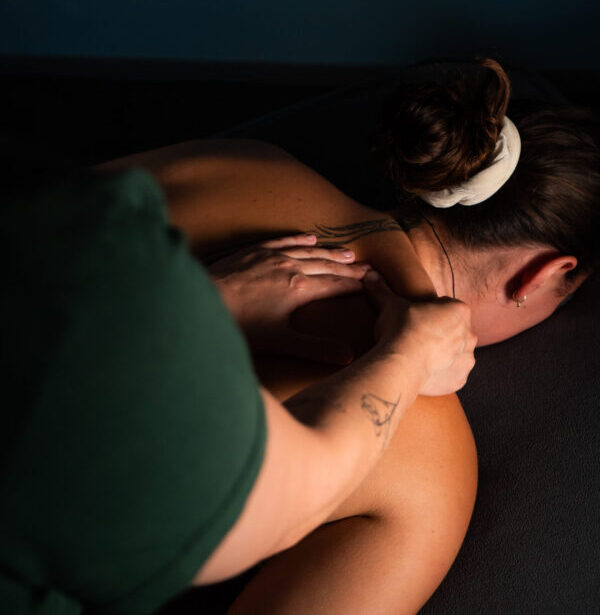
Massage therapy is a hands-on therapeutic modality that can support short-term improvements in movement, comfort and help manage the sensory experience of pain. It is also a valuable tool for overall stress relief and supporting relaxation.
As we are acutely aware MS is an inflammatory condition and it is different in every single person around the world.
As a massage therapist myself, who has and does continually treat people with MS it has been an immense privilege to be a part of their care.
Some feedback I have received includes:
“I was diagnosed with MS around 20 years ago, and a couple of years ago I discovered Sophie and realised she was the missing link in my rehab program. She not only irons out the kinks that plague me with my condition, but time spent with her on the massage table rejuvenates me, and for a short while gives me a space to let go of the noise in my head. “
Another example from another therapist (and husband of a PwMS) Nathan, is
“The biggest thing I can point out is that each person with MS is different with what they need treatment wise, but also what they want treatment wise. I have had clients where we spent most of the appointment just talking about their symptoms and working through what works and doesn’t work for them on a daily basis. We would discuss daily habits, triggers, diet, stresses, things that help them and things that make them worse. Other clients have wanted and benefited from full body deep tissue treatment and yet others only found benefit from light targeted treatments. The other big thing I have found is, and this sounds obvious, to really listen and be aware of the client’s needs and responses.
With MS being a “hidden” disease, someone who takes the time to listen to not only their physical complaints but truly listen to what they say and be their advocate does more for them than we realize. So we need to make sure we treat everyone the same and do what we can to help improve their quality of life. That’s our job.”
Massage Aotearoa New Zealand (MANZ) is the only massage therapy specific membership body in New Zealand for professional Massage Therapists. Their mission is to promote health and wellness in Aotearoa New Zealand through quality massage, and advocate the successful development of the association.
MANZ has 3 tiers of membership, based on the length of the qualification undertaken by the therapist. Level 5 (Certificate in Relaxation Massage), Level 6 (Diploma for Remedial Massage) and Level 7 (Degree level Rehabilitation Massage). Therapists complete ongoing professional development biannually and are able to be affiliated with insurance providers.
Now it is important to state that massage therapy can be used for all different types of people and a massage session is specifically tailored to the individual that walks into our clinic space. Massage can not change any underlying pathology/dis-ease but there has been recent research that supports its use as a safe modality for symptom management. A few studies that are linked below show that regular sessions can help reduce the daily impact of MS-related fatigue, temporarily ease the sensory discomfort of muscle stiffness, and provide deep relaxation that supports overall well-being.
The big “red flag” that gets mentioned over and over again in neurologists appointments is “Are you managing your stress/anxiety?”. As PwMS know all too well, this disease can be QUITE stressful at times, so this question feels like it needs a permanent eye roll (or an annoyed groan) attached to it. However we know that stress increases all those flight or flight hormones and puts our nervous system into a bit of an icky space.
Massage is extremely effective in lowering those hormones as well as activating the parasympathetic (rest and digest) nervous system. Sleep disturbances are also a very common symptom for PwMS. One of the fundamental massage techniques named effleurage was the main intervention used in a study conducted in 2023. The research found that effleurage (long, flowing, continuous strokes) massage was extremely beneficial to the intervention group.
Win one of two $60 Massage Therapy Vouchers!
MANZ welcomes those who are thinking about trying massage therapy to help improve their quality of life and manage symptoms. Any additional information can be found on the website www.massageanz.org.
As part of a new initiative to build relationships with allied health organisations, MANZ is offering two $60 massage therapy vouchers to MS Voice readers. To enter the draw, complete the online entry form. Two winners will be selected at random and contacted directly. Vouchers will be fulfilled through a participating Registered Massage Therapist within the MANZ network, coordinated based on the winner’s location and clinic availability. Terms and conditions apply.


Research articles:

https://pmc.ncbi.nlm.nih.gov/articles/PMC4034721/

Schroeder, B., Doig, J., & Premkumar, K. (2014). The effects of massage therapy on multiple sclerosis patients' quality of life and leg function. Evidence-based complementary and alternative medicine : eCAM, 2014, 640916. https://doi.org/10.1155/2014/640916

https://www.academia.edu/91926387/Impact_of_Massage_Therapy_on_Fatigue_Pain_and_Spasticity_in_People_with_Multiple_Sclerosis_a_Pilot_Study

Backus, D. (2016). Impact of Massage Therapy on Fatigue, Pain, and Spasticity in People with Multiple Sclerosis: a Pilot Study. International Journal of Therapeutic Massage & Bodywork: Research, Education, & Practice. https://doi.org/10.3822/IJTMB.V9I4.327

https://pubmed.ncbi.nlm.nih.gov/36206232/

Zhang, T., Yan, H. X., An, Y., Yin, L., Sun, P. P., Zhao, J. N., & Yan, J. T. (2022). The Efficacy and Safety of Manual Therapy for Symptoms Associated with Multiple Sclerosis: A Systematic Review and Meta-Analysis. Journal of integrative and complementary medicine, 28(10), 780–790.

https://doi.org/10.1089/jicm.2021.0382

https://pubmed.ncbi.nlm.nih.gov/37722787/

Gaballah, S., El-Deen, D. S., & Hebeshy, M. I. (2023). Effect of effleurage massage therapy on sleep disturbance, fatigue, pain, and anxiety in patients with multiple sclerosis: A quasi-experimental study. Applied nursing research : ANR, 73, 151719. https://doi.org/10.1016/j.apnr.2023.151719
Last Updated July 23, 2026